
Five Painters: New Myths
Shaun Roberts, Aarionne Hobbs, Dagon Blank, Alexandria Wooldridge, and Alberto Barbusano Perez
April 11-May 16, 2026
Opening reception Saturday, April 11, from 5:00-7:00 pm
Artists will be in attendance
Panel discussion led by Susie Kalil starting at 6:00 pm
Essay by Susie Kalil
Every generation seems to need, and produce, its own mythology. For a group of young Texas painters, myth is emblematic of the nature of existence—the widening gap between what we hope for and what life gives and withholds. It is about the transcendent self-rightness that exists within and outside us but is so difficult to sustain. Shaun Roberts, Alexandria Wooldridge, Alberto Barbusano Perez, Dagon Blank and Aarionne Hobbs combine a wealth of influences and sources from their personal lives, from current world circumstances, and from art historical sources to create new orders of reality—myths or metaphors—that draw upon big themes: power, heroism, free will, sex, reward and punishment, life and death. In a superficial era rife with subjective truths, these artists form their own myths and aesthetics to reflect societal upheavals. In the process, they shine a light on a more hopeful world of interconnection often hidden within our seemingly darker one.
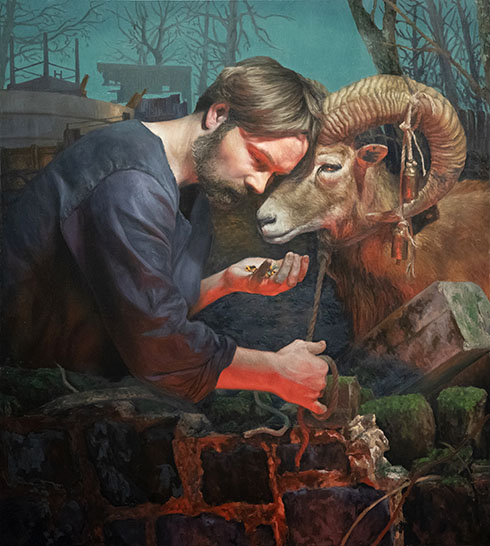
Shaun Roberts, The Hireling Shepherd, 2025, oil on linen, 60" x 54"
In Five Painters: New Myths, presented by Kirk Hopper Fine Art, each artist is fueled by a passion that runs hot. They are united by a belief that art can make the meaning of individual experience visible through metaphorical representations of extraordinary encounters and forces of nature. As a group, their works reach for a sustained examination of the most pressing moral questions of our time. Here, the role of the artist is that of image-giver, poet, philosopher, transformer of raw material, mediator between art and life, and evocateur. The artists crystallize common long-running anxieties—about human obsolescence, surveillance, alienation, diminishing expectations—and project them into exaggerated catastrophic futures. The paintings consider a world spun off-kilter, offering innocents and charlatans, madmen and fools. Don't be surprised if you leave the show feeling both joyous and grim, healed and mournful. Myths, when they're good, are never static. Rather, they stand in a creative relationship to every new time. In this sense, myth is a reality lived. It is an initiating story, an experience of the emotions and the imagination in which we make a significant shift from one level of awareness to another. All of the paintings function as enchantments for our sensibilities, enticing us to pay close attention and then be led inward toward deeper and full dimensions of being. The crux of the art is one that we all confront at some time or another—the world is not as ordered as we thought it was. Their paintings comment on the dangerous human tendency to take refuge in certainty when the truth may be more complicated and elusive. The works are infused with themes that emphasize the spiritual experience as transmitted through the primordial, the mythic and ritual acts, referring to the drama of beauty and decay, faith and sacrifice.
There is, for all five painters, a continuous exchange between art and life. Deeply rooted in the biographies of each artist, the works are nurtured by literature, theater, psychology, as well as core issues of identity, race and class. At the same time, they are concerned with a different world, a new sensibility that oscillates between yearning and discomfort, melancholy and loneliness. Their dreams of unity and reflection of the individual and nature are offset by nightmares of chaos and destruction. Saturated by media bombardment and bad economic news, war coverage and horrifying images of terror, we start hunting for havens of safety. The longing for an intact world and gaze at an idealized safe zone have become a part of everyday life. To that end, these painters develop provocative, poetic counter worlds and take up the yearning for a paradisiacal, magical state without, however, forgetting the abysmal, the uncanny and the mystical lurking behind such idylls.
The young artists are well aware of the development inside art and the debates of recent years, as they are of their predecessors in art history. They create narratives that take us beneath or transcendentally beyond, packed with extraordinary characters, including monsters, heroes, gods, goddesses and prophets. As Joseph Campbell observes in A Hero with a Thousand Faces: "Mythology has been interpreted by the modern intellect as a primitive, fumbling effort to explain the world of nature (Frazer); as a production of political fantasy from prehistoric times misunderstood by succeeding ages (Muller); as a repository of allegorical instruction to shape the individual to his group (Durkheim); as a group dream, symptomatic of archetypal urge within the depths of human psyche (Jung); as the traditional vehicle of man's profoundest insights (Coomaraswamy); and as God's revelation to his children (the Church). Mythology is all of these."1
For the five Texas painters, myth is a crucial storytelling mode that not only permits but actively requires a retelling. In their paintings, myth is where the conditions of irrationality, superstition and enchantment persist—images of wonder that depend on the disconnect between what we know for certain and what we simply believe. They also bring us face to face with fundamental mysteries and questions of human life. Was I born with a purpose? What am I willing to give my life for? Whose voices are overlooked? And which other versions of a story have been ignored? When a mythic moment seizes us profoundly, we feel caught in a spell. We live the dimension of myth by faith, since that deep level teems with mystery and resists rational categorization. Only after we have experienced the rawness of life can we seek an understanding of it, thereby preserving its intensity through narratives that are courageous in scope and imagery. At KHFA, each artist takes us beneath surface appearances, stepping into the gap between themes of domination and self-reliance, between privilege and the thorns of history.
Significantly, Five Painters: New Myths features an ensemble of artists representing Stephen F. Austin State University's School of Art: Shaun Roberts, associate professor of art; Alexandria Wooldridge, graduate art student; Alberto Perez, graduate art student; Dagon Blank, 2025 Master of Fine Arts Alumnus; and Aarionne Hobbs, 2025 Bachelor of Fine Arts Alumnus (currently a graduate art student at Southern Methodist University). "My goal with the students and this exhibition is to bridge the gap between the Old Masters and modern painting," Roberts says. "I am committed to reviving the rigor and work ethic that define true mastery and empower a new generation of painters with the tireless skills of the brush through refined technique and compelling storytelling." Whereas the exhibition signals a return to Classical Realism, each painter employs a distinct visual language and personal narrative, revealing a cohesive dialogue rooted in contemporary reimaginations of myth.
It's no secret that the art market can consume young artists as fast as they emerge. Many become victims of a recent trend, fueled by a zeal for newness that places them in the spotlight before they are ready. Youthful passion is often mistaken for brilliant work, encouraging many artists to expect mid-career surveys before they hit thirty. Indeed, the support system of galleries, collectors and curators that once made it possible for emerging artists to pursue serious careers is in a state of near collapse. There is simply no longer a structure that nourishes such incremental artistic growth. The artists of Five Painters: New Myths are engaged in dialogues that are provocative, fragmented, challenging, demanding—words that describe the time as we speak. To its credit, Stephen F. Austin State University encourages using the art department as a site for argument about what contemporary painting might entail, rather than a place to repeat received behavior. What it confers is a sense that an artist has a responsibility to his or her own integrity. SFASU offers the resources, the space, the freedom, the time, but also an allowance for patience in pushing their work to the next level.
As a result, Five Painters: New Myths is loaded with heady ideas and potential themes eager to be teased out. It partakes of a dreamlike wandering or searching trace. The works breathe life—our own fleeting lives and heartbreaking delicacy—as well as a physical awareness of ourselves within a broader zone of cultural associations and personal desire taken to the limit, including broken families, the dissolution of self and the search for something called home. What these artists share, however, is an insistent freedom in their paintings. They are part of an ongoing quest at SFASU to break through theoretical monopolies. All of the artists want their paintings to be weighted, consequential, aiming to unleash an emotional power that is enveloping, at times close to anguish and violent beauty. They want their paintings to enable us to find our own truth. The issues raised by the works are very much of the moment—the cognitive legitimacy of the artificial or inauthentic, the haunting transformations of childhood experiences that kick around in adult memories, and conflicts between the rendered and the real. Manifest throughout is a tenacious faith in their own art-making processes.
In Shaun Roberts's paintings, the world is unraveling. Anxious women and men, some paired with animals, dodge calamity by clinging to each other as if waiting for a kind of catharsis. The figures who anchor the shallow stage-like foregrounds are isolated, left to their own devices, and rely on themselves. We can interpret the predicaments as states of being lost, perhaps as symbols for the wound in their souls. The characters resonate with us because they evoke the daily dread of life in a society where everything feels increasingly like a scam, a hoax, a grift or a threat. Roberts arouses the sense of distrust and destabilization by placing his protagonists in landscapes ravaged by catastrophe. The women coolly navigate the chaos by playing a harp or seducing the viewer with talismans of superstition. Painters have long been preoccupied with the end of the world or whatever tenuous social order struggles up from the rubble. Is humanity doomed to create dystopian conditions wherever it goes? What would starting over look like?
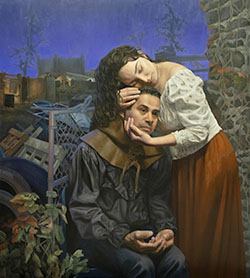
Shaun Roberts, Violet's Dawn, 2024, oil on linen, 72" x 64"
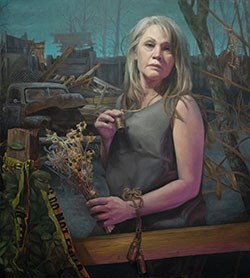
Shaun Roberts, Gate of Allurement, 2024, oil on linen, 60" x 54"
The specifics of a location are rarely tangible in these works, but Roberts has spent his life in East Texas and that influence—rusted cars, crumbling edifices, fires burning in steel trash cans, chain link fences to keep people within and outside of marked territories—constantly pass through the filters of his imagination. Mostly, the individuals are surrounded by the night, a moment of stillness shot through with the transcendent glow of deep blue or purple ether. You can almost hear the silence of these images. There is little movement, save for the playing of harp strings or tinkling of bells that dangle from a woman's wrist. In these paintings, time has stopped in a brutal climate where survival demands a willingness to commit the unfathomable. In the paintings, we can see this destabilization quite clearly, as both buildings and figures lose their bearings. Roberts blows holes between the myth of community and its reality—fragmentation, trauma. Accordingly, he constructs the compositions by means of locked glances between characters, of gestures between fingers, hands and arms that direct our attentions to the central encounters.
As a youth, Roberts traveled with his father, a magician, who performed sleight of hand illusions to mesmerize an audience. Roberts watched him produce fire from his palms and "levitate" his assistant. Over the years, he learned about the angles of visibility and psychology to distinguish a "trick" from magic. That touch of the mystical also pervades the paintings. Only the colors—bright oranges, foreboding brown tones, rich teals and violets—allude to an incandescent turbulence. Here, nature is left unto itself, absorbed in its own ephemeral rituals, a symbol for the imaginary wanderer's landscape of the soul. Indeed, Roberts's paintings contain echoes of Caspar David Friedrich's romanticized but ardent search for authentic sentiments in nature, as well as the Pre-Raphaelite Brotherhood, whose Victorian members painted nature as a web of moral symbols. They source Odd Nerdrum's apocalyptic renderings in which figures emanate from both past and future, in addition to Andrew Wyeth's enigmatic realist paintings that plumb the depths of mortality. Like his forebears, Roberts is not painting a picture but, rather, a moment in time, a story, or a dream. He creates the illusion by braiding the contours with energetic marks and heightening the contrasts. He scrapes and sands to erode the painting until it becomes a delicate artifact that transmits a sense of wonder.
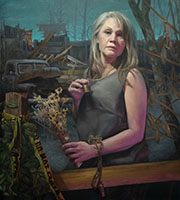
In "Gate of Allurement" (2024), a contemporary woman holds dried flowers in her left hand while grasping a small bell strung around her neck with the right hand. She stares at us with the beseeching look of a seductress, a siren, amid yellow "Do Not Enter" barricades and ominous glowing lights from beyond the piles of broken wood and junked cars. For "The Hireling Shepherd" (2025), Roberts portrays himself head-to-head with a ram. One hand pulls the rope that is looped around the animal's neck; the other holds an offering of wildflower petals. Luminosity suffuses the scene, flooding and glossing each of the faces, each expression beautifully particularized from the light source.
"Violet's Dawn" (2024) features a forlorn young man who sits with hands folded in his lap. A woman dressed in white ruffled blouse and long red skirt stands over him, while cradling his head in her hands. The woman's long hair cascades along his head and shoulders as a form of protection. The overall feeling is one of desperation amid a blasted world. Yet their bodies are tightly knitted—the human bond is a means to fight back in ways both spiritual and physical. Roberts reminds us that even a fragile communion with others will always generate more strength than remaining crouched in anguished solitude.
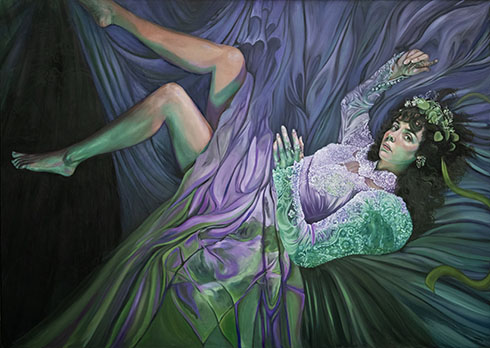
Alexandria Wooldridge, Willow, 2026, oil on canvas, 60" x 84"
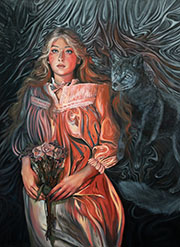
Beauty abounds in Alexandria Wooldridge's paintings of young women dressed in Victorian wedding gowns, reposing on luxurious satin sheets or standing amid sensually lit landscapes. Her enchanting females are dreamy, haunting and retain an emotional core in which the past, as in Victorian art, charges into the present and reshapes it. Perhaps reflecting our current fraught era of American feminism, Wooldridge's particular assembly is defined by fantasy, frustration and catharsis—and entrancing an embarrassment of riches along the way. Each painting features a single pretty girl in a silky heavily embellished or pleated garment, glowing with cake icing hues that make the fabrics gleam with jewel-toned iridescence. At times, Wooldridge positions her figure on a floating bed of voluminous sheets, then skews the perspective to enhance a sensation of vertigo. Is the woman falling? Or are we looking down on her caught up in swaths of fabric? Either way, the disorientation spins the viewer's eye from edge to edge. Mostly, the women have long curly hair and sharp elbows—the sweetness and air of innocence is almost confectionary, yet belie an underlying darkness within each narrative.
Suspicion of beauty, of course, will always carry the inverted logic of framing pretty people and things as vain and shallow. However, Wooldridge is among a growing cadre of artists from coast-to-coast who reaffirm that women should paint, and do, whatever they want—beautiful, sexualized or feminist images—as long as they are by a woman and true to her point of view. Wooldridge's particular feminine figuration examines youthful beauty but jostles it, coalescing with her own ideas in regard to myth and desire. Still, in an era in which a woman's desire is often thought of as inherently dangerous, Wooldridge's unselfconsciousness about how she portrays true yearning can seem almost revolutionary. As in Roberts's paintings, Wooldridge has absorbed the Pre-Raphaelite ideals of Romantic Medievalism and classical mythology. She also adopts their principles of carefully observed detail, bright colors and intensely emotional subject matter. This line of thought—that beauty must be deeply rooted in the artist's psyche—is embraced by Wooldridge as yet another means of expressing the value of individual experience: sumptuous color, pattern and form and how those make us feel.
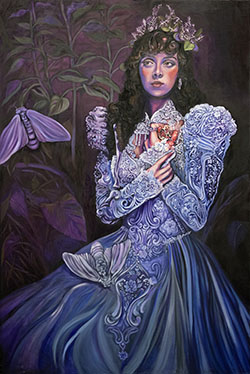
Alexandria Wooldridge, Persephone, 2026, oil on canvas, 72" x 48"
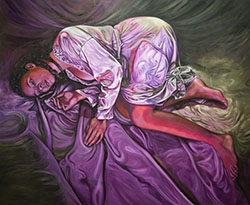
Alexandria Wooldridge, Ophelia, 2026, oil on canvas, 60" x 72"
"Willow" (2026) features a young woman seemingly falling into waves of satin sheets, her legs and arms jutting out, flailing or akimbo. Wooldridge takes the title from the Pre-Raphaelite use of the complex symbol associated with forsaken love, deep longing and mourning. Here, her fixing gaze and garlanded "crown" emit a special aura. The brocades and tiny pearls sewn into the dress are rendered with meticulous brushstrokes of greens, purples and pinks. The garment, in fact, appears almost weightless as it alternately clings tightly to her smooth flesh or pools in rippling furls and folds. Wooldridge evokes the pale softness of her skin and face, voluptuous lips, tumbling brown locks and expressive soulful eyes.
In "Persephone" (2026), the young woman stands before us in her wedding dress, arms drawn up and bent at the elbows, her hands grasping a pomegranate. Persephone—or Prosperine—was the daughter of Ceres and Jupiter. Pluto, the god of the Underworld, fell in love with Persephone and abducted her as she was picking flowers. While in Hades, she broke the fast by eating a pomegranate and as a result was bound to the Underworld. Ceres convinced Jupiter to allow Persephone to spend part of the year with her; the alteration of Persephone's stays below and above the earth correspond to the rhythm of the seasons and the renewal of vegetation. Accordingly, Wooldridge surrounds her young woman with a giant death hawk moth, blooming flowers, lush green vines and tall plants. The longer we look at this painting, the more there is to see. The feathery strands of Persephone's hair and opalescent jewels draw attention to the paint itself, applied with near-obsessive brio.
For "Ophelia" (2026), sourced from the Pre-Raphaelite artist John Everett Millais, who painted Shakespeare's tragic character of innocence, beauty and death, Wooldridge poses a young African-American woman on a sea of rippling purple satin sheets. Viewed slightly from above and at an angle, our perspective hits at the woman's left arm, elbow and right knee, which prop up her body on its side. Dressed in a creamy lavender-green gown, the strands of her braided black hair wrapping around the neck, Ophelia seemingly floats in a mystical ether. In the process, Wooldridge imbues the work with an almost hidden energy and electrified light. Indeed, there's a power or tension that is embedded in these paintings—what makes an attractive body or even an acceptable one; how the rhythms of certain gestures lead the eye around the composition. In many respects, Wooldridge's women, as innocent and cryptic as they are, take on the character of a conquering force: they claim their world through play, or even by getting lost in it. And yet, there is promise made by all of them—a becoming of something that is not yet entirely formed, but an openness connected to the romantic desire that imagines compelling feminine worlds.
It's been said that the gods send us sorrows so that we will have stories to tell. Over a decade ago, Alberto Barbusano Perez fled his native Cuba in search of artistic freedom in the United States. He didn't turn his back on Cuba's fascist regime—the draconian crackdowns on dissent, the suspension of civil liberties and mass incarcerations—rather, he grappled with them, shaping that reality into a truth-telling arena that spoke to the private and the public, the beautiful and the brutal. Through painting, Perez began to carve out a space of creative freedom, then used this freedom to underscore what he owed to others in his homeland. Having the will to leave everything and everyone he loved behind to seek something new, is a profound act of self-creation. At best, Perez did what all significant artists do: he made the deep sorrow he experienced in his youth the subject of the work itself. He filtered the moral complexities of an authoritarian government through layers of memory; he studied the great Spanish painters of the 18th and 19th centuries, Francisco de Zurburan and Francisco de Goya, who exposed the violated emptiness of our fallen nature. The taproot of their extreme realism is fixed deep in Perez's world, and that imagery pervades his work. Goya's theatrical visions, especially the haunting final suite of Black Paintings, serve in many ways as the young painter's direct source. The horrific "Saturn Devouring his Son" (1820-1823), in which Goya envisions an ogre chewing the head off a bloodied body, was certainly an allegory about Spain's cannabalization of its own people through civil war. Yet the savage beast's demonic eyes also reflect psychological struggles with and fear of the abyss, the unstoppable consumption of time. Goya speaks to us with an urgency that no artist of our time can muster; without question, nothing surpasses the intensity of emotion found in the Black Paintings. For Perez, however, Goya's "Saturn" touched a core of terror going back to childhood—a primal, possibly preverbal fright that Perez aimed to project from that time into ours—a landscape where the borders between nightmares and waking life are porous.
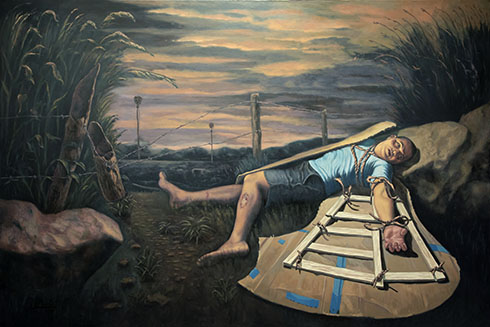
Alberto Barbusano Perez, Wings, 2026, oil on canvas, 64" x 96"
It's no wonder that Perez turned to Goya's protests against the abuse of human possibilities as the starting point for his own painting. As Perez experienced it, when corruption goes over the top, when all human possibilities are denied with ruthlessness, then the ravager and victim are made bestial. "The Stone of Rhea" (2026) depicts a monstrous giant with crazed eyes charging toward the viewer, a swaddled body held to its lips. The title refers to the Greek mythological Omphalos, representing the stone that Rhea, the Mother goddess, wrapped in cloths and fed to her husband Cronos, who believed it was his son Zeus. The ploy allowed Rhea to protect Zeus from being eaten, thus saving her youngest child, who would go on to challenge his father's rule and rescue his siblings. Here, the ogre's mane of hair swirls around its head and into the background with the force of a vortex. The Cuban national bird—the trogon or tocorora, with its red, white and blue feathers, has been smashed by the weight of the giant's foot. At right, an hourglass rolls across the shallow foreground; a sickle has been propped against a crumbling brick wall. At left, a small child, a symbol of lost or threatened innocence, hides behind a boulder and points to the savagery above him. The child's left hand delicately caresses a companion trogon, which perches on the chiseled rock. Perez paints with full arm gestures and precise, jabbing brushstrokes. Burnt umber is lightened by swipes of rust, creamy whites and granite grays. Elsewhere, the blunt force of this painting is expressed down to the suggestion of dirt and blood—a dark alizarin crimson scraped back to emulate the dull crustiness of a twitching body.
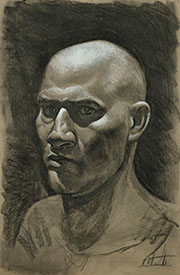
In Perez's paintings, the flesh is a battleground between ignorance and uncontrolled brutality on the one hand, dignity and grace on the other. The unique power of his work is due to the fact that at no point do we ever doubt Perez as bearing witness to the absolute terror and horror of injustice. "Osorbo's Resistance" (2025) rekindles the fierce suppression that his friends and family continue to endure in Cuba. With this in mind, the artist renders a full-head portrait of a man who was imprisoned for speaking against the government and has shockingly sewn his lips together in protest. It is precisely this unconditional entry into sociopolitical conditions, the careful modeling of smoldering colors, and the historicized setting that bears us away into new temporal dimensions, a transcendence of time. Significantly, Perez enshrines how this man suffers and survives—the horror, but also the grace of our attentiveness to one another. Perez directs our focus to the man's glassy hazel eyes, rendered in modulated tones which seemingly communicate what cannot be physically verbalized. In doing so, Perez seals us on intimate terms with him as consciousness itself.
Every painting is shaped by an absence, a solitude, some type of violence, some event that may be difficult to consider. Perez brings us into unthinkable places. His paintings provoke a moral passion to confront and challenge our dehumanizing complacency. Again and again, Perez asks us to come ever closer and see more clearly; how we take refuge in our helplessness; how not to resist is to be indifferent and to be indifferent is to condone. In "Wings" (2026), we encounter a young boy lying on his back in a grassy field alongside a barbed wire fence and broken wooden posts. Dressed in a blue T-shirt and shorts, the boy's arms are spread out, tied by ropes to homemade "wings" of cardboard, wooden slats and blue packaging tape. One leg is straightened, the other bent and bloodied, his bare feet jutting into the viewer's space. The young man has attempted to fly by jumping off the post, which has cracked into splintered pieces on the ground. In the fall, the young man's head has hit the large rock on which he lies prone. The cardboard wings take on the configuration of a crucifix; his desperate attempt at freedom a kind of reckless sacrifice. His eyes are wide open. Does he see a vision? Is he stunned, or dead? Framing the tragic scene are masses of tall weeds and plants—smoothly painted with fleeting strokes—that focus our attention to Cuba's luminous dawn skies and palm tree in the distance. We experience the physical force through Perez's dabs of paint and swaths of color—earthy browns, dark greens, grays, pinks and sharp dashes of white.
Admittedly, Perez was inspired by Pieter Bruegel the Elder's "Landscape with the Fall of Icarus" (c. 1560), which depicts the Greek legend of Daedalus and his son Icarus, whose sets of wings, using feathers and wax, melted when he flew too close to the sun. Icarus plummets into the sea and drowns, while a ploughman and shepherd go about their daily business. In Perez's painting, life is similarly ungraspable, mysterious and tumultuous. Life happens in the corners where people are disinclined to look. It's as if he wants us to be present in another's suffering as a means of breaking down divisions between people. As "Wings" conveys, unity is often the goal but never the reality. A void of compassion leads to sadness, despair and horror. That void also makes our humanity contingent, unpredictable.
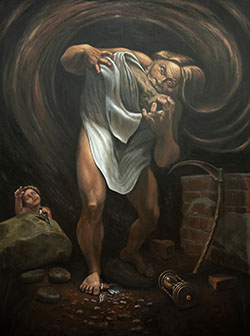
Alberto Barbusano Perez, Saturn Devouring His Child, 2026, oil on canvas, 96" x 72"
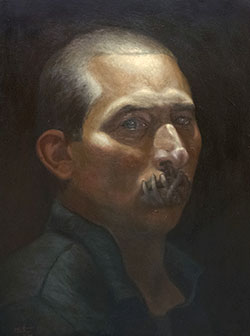
Alberto Barbusano Perez, Osorbo's Resistence, 2025, oil on canvas 48" x 36"
Over the years, painting, and especially the rhetoric of "mastery" that surrounded it, has seemed almost like an enemy medium, spurred by a rejection of the macho grandiosity associated with ambitious scale. For strict adherents of "academic" critique, painting could not escape being categorized primarily as commodity. How, then, is it possible to paint without impulsively buying into the hierarchical assumptions that painting has towed in its wake? As it turns out, twists of contradictions which previously resulted in a rejection of painting altogether may now be seen as a renewed confidence in its presumed status. Over and over, history has shown us that the times dictate what the art will be. Spend time with the paintings of the five artists and it becomes clear that their works stem from a contention with compelling issues: love, death, spirituality, beauty. Mainstream themes in Western art raise their heads alongside core concerns: a ramped up campaign of mass deportations; anxieties over the conflicts in the Middle East; climate threats; less food. For artists of such conviction, the world is estranged, life is absurd. The revelation of human failings is a necessity and the documentation of bearing witness is a responsibility. What sets these young painters apart from the pack are their keen insights into storytelling—robust, full, layered and juicy. Stories that feel multidimensional and find connections between all people, while conveying the unique mix of desire, delusion and hypocrisy swirling in each subject. Stories that cross the line of gender, race, culture and, most crucially, class. As revealed in each series of paintings, the nature of storytelling is a matter of finding the story. Their backdrops are both beautiful and sinister. To be sure, existential tropes of life, suffering and dissolution are potential minefields if tackled clumsily. Yet none of the artists flinch from such challenges, regarding them as ticking-time-bombs and as true mirrors of humanity,
If a painter is going to represent, then what will he or she represent? To that end, the question of subject is unavoidable. The canvases of the Old Masters, filled with ever-larger and more spectacular compositions, became "stages" on which they could present personal psychodramas, mythical tales or tragic narratives. Such theatrical arrangements also allowed viewers the possibility of engaging in the action. Indeed, from the French Revolution on it has been history painting that may constitute the medium's foremost claim to significance. It was in "salon" painting that the artist could seize the opportunity to marshal the mastery of composition, intellectual rigor and potentially impact the course of public events.
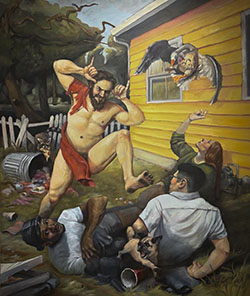
Dagon Blank, Returning to the Fold, 2024, oil on canvas, 60" x 84"
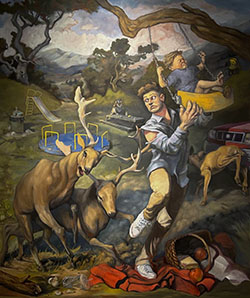
Dagon Blank, Protectors, 2024, oil on canvas, 60" x 84"
For Dagon Blank, history painting allows him to take an anthropological delight in presenting the folly of human behavior, thereby infusing his allegorical works with commentary on our rampant consumerism and futile existence. Inspired by the dramatic mythological paintings of Flemish Baroque artist Peter Paul Rubens and, especially, the dazzling compositions of Francois Boucher, which came to typify the Rococo style at its brilliance, Blank has produced an ambitious 16-foot long painting that will surely induce nervous laughter about society's abysmal moral standards. His mural-sized "The Castigation of Tantalus" (2025) is an immersive tour de force that reignites the Greek mythological figure who lent his name to the word "tantalize." The son of Zeus with Saturn's daughter, Pluto, he incurred the god's wrath and was condemned to an eternal torture of hunger and thirst in Hades. Tantalus was submerged in a pool beneath a fruit tree; the water ebbed whenever he tried to drink and the fruit receded whenever he tried to eat. For Blank, the myth seemed to be a fitting allegory of our own uncertain times. A younger generation is helpless to keep the demons at bay in a hostile world where everything is commercialized; it's impossible to find a job; rents are astronomical and reality is a collective delusion.
To that end, Blank's painting radiates an air of shame, despair and powerlessness. It seems to ask: How can we trust ourselves to make the world a better place when we've already blundered so spectacularly? Viewers don't stand in front of the painting so much as actively traverse the interwoven narratives, edge to edge. At center, a pot-bellied god sits in a tree, while leaning against a bounty of luscious fruit. He holds out a pole with an orange dangled at the end of its rope, teasing the horde of men who push and shove each other in the rushing water below. On the left, still more men and women, all ages and ethnicities, struggle or float in the roiling currents. A woman carries a baby in her arm; a middle-aged man wearing glasses is dismayed at being caught in the whirlpool. Each, however, is a fully rendered, individualized portrait. All kinds of trash—plastic red drink cups and six-pack loops; crushed aluminum cans and Amazon packages—are tangled up with the figures themselves or beached on the rocky banks. In the upper right corner, the handle of a plastic white "Thank you" bag is caught on a spindly branch and flutters in the wind. The red tail lights of a pickup truck carrying sandbags mysteriously glow through the fog and mist. Elsewhere, transient atmospheric effects and windblown clouds imbue the narrative with emotive significance. Mythical creatures and satyrs function as tricksters. At far right, a satyr balances at the edge of a boat filled with squirming fish. The diabolical figure with leering expression pulls and knots the ropes attached to the fishing net through a tree. Another winged satyr crouches in the shadows of a tree branch near the jovial god. The entirety has a register of grays, creams and earthy browns that contrasts with deep blues, greens and oranges, like warm and cool temperatures colliding to create a storm.
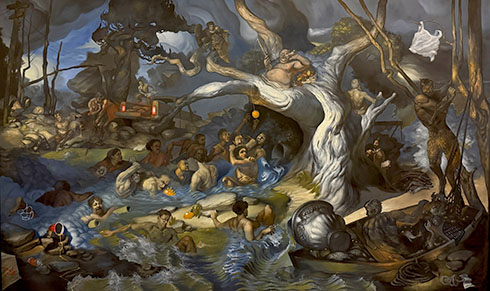
Dagon Blank, The Castigation of Tantalus Date, 2025, oil on canvas 10' x 15'
Throughout, Blank conveys a riveting sense of color and drama in nature. Brushwork flows like butter, smoothly applied in full arm gestures, as careful jabs and staccato strokes. That physicality—the sensuality of layered, wet-into-wet oil paint, combined with the robustness, even near brutality of the figures themselves are essential elements of Blank's churning chaos. With this in mind, he fuses mythology into an amalgam of dreams and trauma, rapture and yearning, as seductive as it is disturbing. For Blank, they are dubious promises—the traps of salvation and misunderstood ideals.
In Aarionne Hobbs's paintings, myth initiates us into mysteries that illuminate our lives and leave us forever transformed. For Hobbs, the wellsprings of myth, both collective and personal, are a means to explore themes of transition, from upper to nether worlds, on a journey bound for redemption and ecstasy. Hobbs catches something in the air—of the forces bearing down on us through environmental fragilities and our current social malaise. Youth and maturation is not only a process rooted in our biological existence: it is also an experience, a series of events, moments and acts lived by an individual. This experience, this path through the maze of inner life, composes our journey. And just as life is diverse, the shifting planes of our personalities come from shifts in the social and cultural constructs around us, How do we identify ourselves? How do we settle into other people's expectations for our identity? In the instant when we embrace both sides of any experience, we are stepping through a gateway, a threshold moment that initiates us into the world as it is—a crosscurrent of emerging patterns, a world that changes and transforms us in the very instant of contact. Such drama is spiritual, as it addresses the conflict between the inevitability of decay and our lust for preservation.
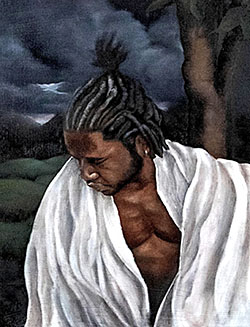
Aarionne Hobbs, Untitled (Self-Portrait), 2024
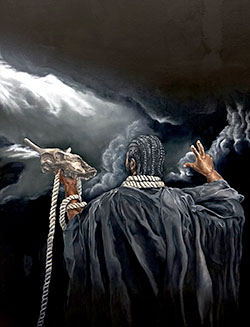
Aarionne Hobbs, A Wicked Offering, 2024
If, indeed, art is potent to the degree it merges with life, then how does a painter forge an emotional connection with the viewer? There are people we touch and don't touch. What's at issue is not only the difference between the fictive and the real, but a much deeper set of oppositions between the private and public, between the self and the world at large, between hidden obsessions and our daily passage with one another. An image of a figure is an inoculation against the dimming of memory. The likeness of a face is a form of gesture—a relation of sizes, angles, values—in other words, knowing how to measure with the eyes to illuminate the light within. Such concerns are addressed through the interlocking themes to which Hobbs constantly returns in the self-portraits. In these paintings, Hobbs renders the surface but also his character. Everything shows—the face, after all, is the center of the senses—loneliness, joy, sorrow, but also how fate and internal struggle, beauty and fear conspire to an uncertain future.
Who has Hobbs become? How does he see himself? Taken together, the self-portraits serve as a kind of manifesto for an art based in belief in the underlying unity of the visible and the hidden, of external and internal worlds. We become intimately connected to Hobbs because he makes his self-images feel emotionally as well as physically alive. For "Untitled (Self-Portrait)" (2024), Hobbs is positioned against a tree trunk amid a pastoral landscape and turbulent dark skies. His head is bowed with chin grazing the right shoulder; his black hair is tightly braided into rows that fall gently over the left ear and gathered like a flowering sprig at top. A white mantle or cloak covers Hobbs's bare torso, its volumetric pleats and curves cascading like rivulets from the shoulders.
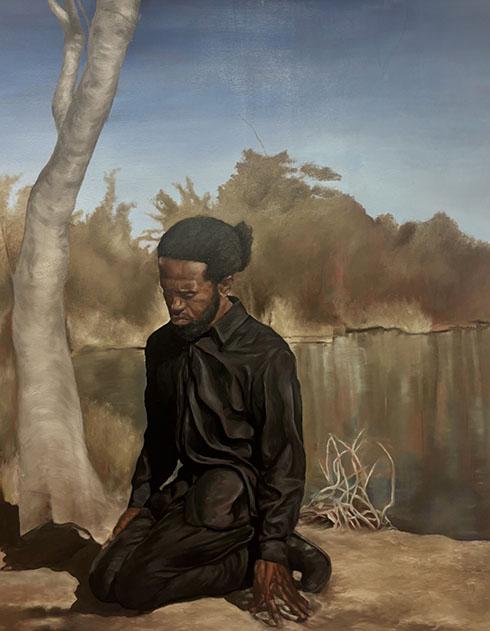
Aarionne Hobbs, Internal State, 2026, oil paint, 60" x 42"
Conversely, "A Wicked Offering" (2024) depicts Hobbs with his back to the viewer. Wearing a dark, loosely fitting robe, Hobbs holds a cow's skull in his left hand while signaling with three fingers spread apart in the other. A thick rope is bound around his neck, twisted in knots at his wrist and pulled through the skull like a slithering serpent. Here, he seems to conjure the wrath of the heavens, a collision of electrified clouds and dark thunderheads in the distance.
For "Internal State" (2026), however, Hobbs sits on his knees in a shallow foreground with a luminous, shimmering pond, bare tree trunk and autumnal foliage behind him. The landscape is a vessel for the soul. Our self is mirrored in it, just as landscape echoes in us. His head is bowed in contemplation, the tips of his bony fingers touching earth. Dressed in black shirt and pants, his black hair pulled back in a bun, the overall effect is that of deep reverence. There are echoes of Thomas Cole's "The Voyage of Life" (1840-42), a series of four paintings—Childhood, Youth, Manhood and Old Age—that synthesize three concepts: Life is a pilgrimage; one's life can be divided into distinct stages; and the course of one's life allegorically serves as a journey. For Hobbs, however, the self-portrait is a way to convey the essence of his personality, his inner being, even as it blends the confrontational and the voyeuristic.
Hobbs's theatrical self-portraits are fraught with apprehension: the action is primarily psychological and emotional, conveyed in subtle glances and gestures. All three paintings, however, depict the figure in struggle—a healing of the vulnerable inner child that simultaneously confronts and engages viewers. Turning one's back on the world as in "A Wicked Offering" is as much about exposing its assumptions as it is opening a space for imaginative play. The dynamics of hiding and revealing staged by the figure structure the narrative: viewing the young man from behind robs us of the illusion that we are participating in the promise of his gaze. Moreover, as idyllic as the scene of "Internal State" appears, it leaves us wrestling with the strange mix of diffidence and intensity, the fragility of life itself. In the process, Hobbs reflects our fears back to us, even as he grapples with the realities of who we are, a spiritual tenor both ominous and redeeming.
Throughout Five Painters: New Myths, each artist makes us cling to the sorrow and beauty of the world, newly reminded of how fleeting it all is. How ephemeral and transient we all are. Emotion and truth are scarcely kept apart; mythology and world spirit are ducking under their own illusions. Yet a willed sincerity channels the repeated trials of these painters to put aside the crises of faith in the very validity of their medium. The result is a wildly progressive gathering that feels unsettlingly genuine at its core.
Five Painters: New Myths is organized by Kirk Hopper Fine Art, Dallas. The exhibition travels to the Cole Art Center, Stephen F. Austin State University, Nacogdoches, June 4-28, 2026.
1 Joseph Campbell, The Hero with a Thousand Faces, Princeton University Press, New World Library, Novato, Calif., Third Edition, 2008, p. 330.

Kirk Hopper Fine Art represents contemporary artworks in all media, emphasizing emerging and established Texas artists.